
Lead-free KNN-based Thin Film with Giant Piezoelectricity
Opportunity
Due to its capabilities for high sensitivity and low power consumption, piezoelectric thin films are in high demand. They are used across industries in applications such as sensors, medical equipment and consumer electronics. The global market for thin film piezoelectric devices is expected to reach US$15.3 billion by 2026, growing at a CAGR of 13.9% from 2021 to 2026.
However, conventional films (such as lead zirconate titanate (PZT)-based thin films) contain lead, a toxic metal that has been banned in various countries. Even though lead-free alternatives like potassium-sodium-niobate (KNN) thin films exist, their piezoelectric properties generally fail to match up to their lead-based counterparts. Furthermore, difficulties exist in the fabrication of KNN-based thin films, often requiring complicated processes and expensive dopants.
Technology
This novel technology describes a lead-free KNN-based piezoelectric thin film with the formula (K1-xNax)yNbO3-where 0≤x≤1 and 0.64≤y≤0.95-and its production method through sputtering.
By adjusting the stoichiometry of target composition during the sputtering process, this method increases the density of antiphase boundaries-resulting in a higher piezoelectric coefficient (d33*). This simplifies the process as compared to conventional methods used to increase d33*, which raises the film’s reproducibility and makes mass production possible.
At an applied voltage and frequency of 58.3 kV/cm and 1 kHz, the film demonstrates an effective longitudinal d33* of 1621.9 pm/V-exceeding that of conventional PZT- and KNN-based piezoelectric thin films. Using this film, lead-free devices with higher sensitivity and energy-efficiency can be produced.
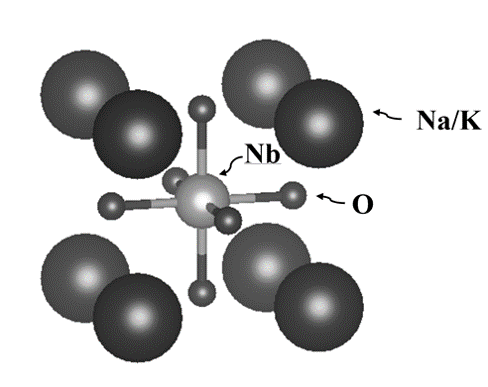
A perovskite unit cell of (K, Na)NbO3.

Download
